Tesco said today that its UK online grocery sales surged after customers used its click and collect service and it opened more online warehouses.
Sales in the year to February surged 12.8 per cent to £2.3 billion, it said this morning. By comparison, rival Ocado said in February its sales had increased 11.4 per cent to £716 million in 2012.
Tesco has five dedicated online grocery delivery warehouses after opening Crawley in January and another site is scheduled to open in Erith near Dartmouth later this year.
It has also boosted its Tesco Direct service, which sell non-grocery products, from 75,000 items at the beginning of the year to 300,000 in April.
Tesco chief executive Philip Clarke said on his blog: 'For many years, we bought land and developed it to build stores, mainly big stores. [The Strategy] served us very well and was part of our success in the 90s. A year ago I said we weren’t going to do as much of that anymore. The large stores we have are great and we are doing a lot of work to make them more vibrant and relevant for today’s customers, but we won’t need many more of them because growth in future will be multichannel – a combination of big stores, local convenience stores and online.'
It said 120,000 customers have signed up to its Delivery Saver service accounting 25 per cent of weekly sales. It also said it has 150 locations at stores around the UK for its click and collect service with plans to double the number. It has 1,500 click and collect sites for its Direct division.
Tesco's global online sales rose 13 per cent to £3 billion in the year.
Tags: Tesco, Tesco Direct, Delivery Saver, click and collect, Ocado, online food delivery, online food ordering, supermarket, online sales, internet sales, ecommerce
Wednesday, 17 April 2013

Tuesday, 16 April 2013
Online boosts Charles Tyrwhitt sales to £100 million
Men's shirt specialist Charles Tyrwhitt said sales have been boosted by its online and catalogue business.
Profit increased 5 per cent to £7.6 million in the year to last July and sales increased 25 per cent to £98 million. Sales in the current financial year ending in three months will be about £130 million, founder Nick Wheeler is reported to have said.
Wheeler said the firm's internet site and catalogue account for 75 per cent of its sales. The firm has 21 shops including outlets in the US.
Charles Tyrwhitt will continue to open stores regionally in Britain and may reach about 35. Wheeler said the stores help drive internet sales and give people more confidence to shop online.
Tags, Nick Wheeler, Charles Tyrwhitt, fashion retailing, shirts, formal wear, internet retailing, online retail, online shopping, ecommerce
Profit increased 5 per cent to £7.6 million in the year to last July and sales increased 25 per cent to £98 million. Sales in the current financial year ending in three months will be about £130 million, founder Nick Wheeler is reported to have said.
Wheeler said the firm's internet site and catalogue account for 75 per cent of its sales. The firm has 21 shops including outlets in the US.
Charles Tyrwhitt will continue to open stores regionally in Britain and may reach about 35. Wheeler said the stores help drive internet sales and give people more confidence to shop online.
He said some high street retailers continue to 'rip off' their customers by over charging for their products. ‘We try to keep things simple. It’s about quality, service and value, but particularly value,' he said in the report.
Tags, Nick Wheeler, Charles Tyrwhitt, fashion retailing, shirts, formal wear, internet retailing, online retail, online shopping, ecommerce
Monday, 15 April 2013
Comment: Online sales rise just 6.6%? Don’t panic
Last
week the British Retail Consortium said online retail sales grew by just 6.6 per cent
in March.
The
data passed virtually without comment despite the suggestion that online sales
in the UK
That
figure, from the UK
Other
figures suggest a different picture. Barclaycard, which tracks about half of
all spending, says online sales in the month rose 12 per cent. Internet
retailer’s body, the IMRG, said the increase was 13 per cent. The issue is
neither of those actually measure pure retail sales (they include spending on
holidays and flights for example).
But
several retailers also said last week that online sales continued to grow rapidly
(at least two of them were relatively late to the online party, it has to be said, so sales still have steep growth potential). Marks
& Spencer said online sales in the three months to the end of March
increased 23 per cent. Mothercare said its Direct in
Home sales increased 18.2 per cent and total sales falling 4.8 per cent.
There are always going to be oddities in the data and unusual months. But the
BRC-recorded slump also came in a month where anecdotal evidence seemed to
suggest freezing temperatures and snow had convinced many shoppers to take to
the internet rather than the local town centre.
Is
there something about the BRC sample that skews its online sales? Sample size
may be an issue for them (they only take data from their members who tend to be
larger retailers) and particularly where internet data is concerned. The Office
of National Statistics retail data has the unrivaled sample size of the ‘900
biggest’ retailers in the country and the numbers always have the ring of
truth.
They
are due within the next week. So, like we said, don't panic just yet.
At
the very worst take all statistics with a pinch of salt and do a bit of
triangulation. Somewhere around 10 per cent or slightly above feels about right
at the moment.
Tags: online sales, online shopping, ecommerce, British Retail Consortium, high street, internet sales, Barclaycard, Marks & Spencer, Halfords, Mothercare, IMRG, ONS Retail Sales, Office of National Statistics, UK retail sales
Tags: online sales, online shopping, ecommerce, British Retail Consortium, high street, internet sales, Barclaycard, Marks & Spencer, Halfords, Mothercare, IMRG, ONS Retail Sales, Office of National Statistics, UK retail sales
Sunday, 14 April 2013
The Online Shop That Opens in 13 minutes
Yesterday we told you about a site promising
you an online shop in minutes - Tictail. Well, it took 13 minutes in all and we only have one
product to sell but I think we did it. Faster than opening one on the local high street that's for sure.
Dr Fang's new clock shop is a fully functioning Pay Pal-linked store with terms and conditions and even a returns policy. Ok, it only has one product (a rather hastily snapped and not particularly remarkable clock that hangs on the office wall – not for sale!).
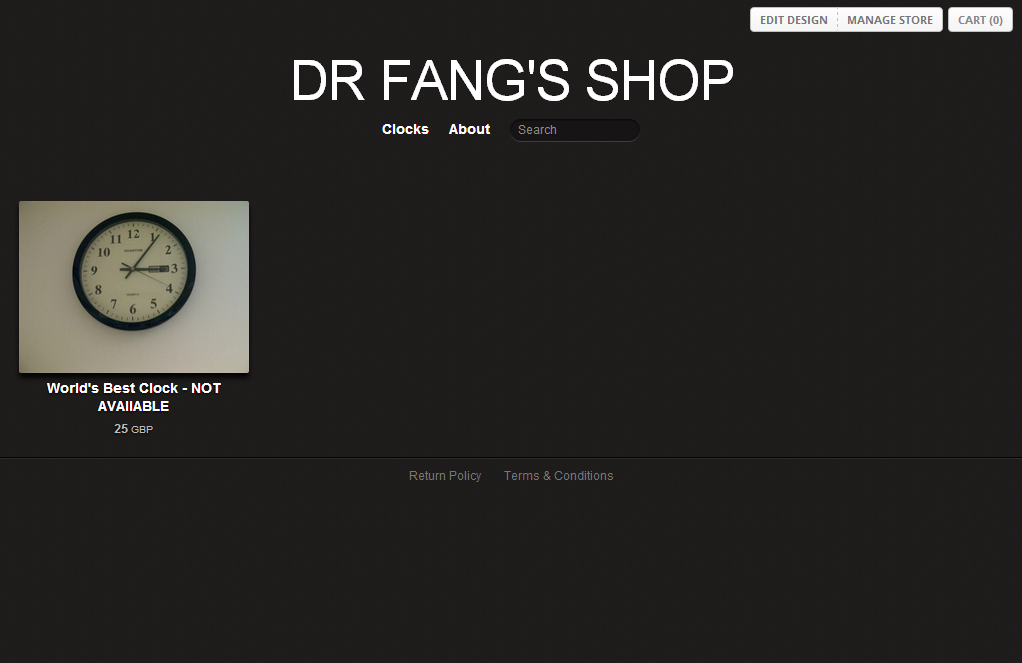
If you really want a swift start, you can take photographs with a decent smartphone and email them straight to your PC or laptop. If that statement confuses you, you may have to go back even further and come back here when you've figured out what a smartphone does....


Tags: Tictail, online shopping, e-commerce, online retailing, internet shop,
Dr Fang's new clock shop is a fully functioning Pay Pal-linked store with terms and conditions and even a returns policy. Ok, it only has one product (a rather hastily snapped and not particularly remarkable clock that hangs on the office wall – not for sale!).
We are not promoting the software we used. We read about Tictail for the first time yesterday and covered it in the Blog. We have had no contact with the company but it,
and others like it, are clearly thrusting smaller traders into a brave new
world.
First you need to have an email
account. Pay Pal, Facebook and Twitter accounts would be useful too but not
necessary for the start-up process.
From then on its mindbogglingly simple. Enter a
shop name; then products if you have photos handy (see below) - but again not critical for the initial start-up. Link to your
Pay Pal account which you’ll need before you can trade. Twitter and Facebook will help you promote the site and you'll be prompted to alert your followers as you go along and add new products (if you have any followers, better known as potential customers - finding some is another story altogether, I'm afraid).
I've glossed over some of the complexities here. For example, everything we know about online shopping suggests photos are key. Get a decent camera, use a decent background in a well-lit room (not so well-lit it wipes out all the features of the product) and remember this is critical information on which your customer will base their purchasing decision. Don't take photos of products on your coffee table or on a table in your cramped stockroom. They will look awful. My photograph was taken for speed and I would not dream of using that on an actual site.
If you really want a swift start, you can take photographs with a decent smartphone and email them straight to your PC or laptop. If that statement confuses you, you may have to go back even further and come back here when you've figured out what a smartphone does....
Products can be divided into menus. We created a menu for ‘clocks’, then a sub file for ‘white’ clocks and another subset for white ‘round’ clocks. But it seems you could
pretty much go sub-categorising until your heart’s content.
By the way, in the example below, our clock here is marked 'not available' just in case someone tried to buy it while we were setting up the site!
You are also invited to add a returns policy
and other terms and conditions but these are suggested for you (please note, we
have no idea how comprehensive the offered policies are or how far the t's & c's will protect you
legally).
In next to no time (as we said, 13 minutes) we're looking at Dr Fang's Shop front
with no phone calls, emails or any contact with the outside world whatsoever.
It’s not the most beautiful thing in the world but at this stage in your online retail career, who cares. The fact is your lovely products are now finding a whole new audience. We then went back to visit as a shopper. You can then click on the clock, add it to your shopping cart and you are then invited to enter your details and pay via Pay Pal.
Tictail is, on first impressions, a chunky and hardly beautiful opportunity for the digitally averse. Like a set of Duplo bricks for those of us too scared to play with Mechano. I’m sure there are ways to finesse your Tictail site but that's between you and them. We're also absolutely sure than some retailers would prefer do do things differently. But the point is, in 2013 there are options that are quick and will meet the needs of those who feel retailing, not software programming, is their calling.
That’s it. Now go and find some customers.
Saturday, 13 April 2013
Saturday tip: your first online shop in minutes?
An online shop you can set up in minutes? Either internet trading really is for dummies these days or that is a boast too far.
If true, and we intend to establish just that, this could be a brave and uncomplicated new word for the digitally inept. It's free too. We'll be letting you know what we think in a day or two once we've tried it out.
According to a review of the Tictail business in The Economist, prospective traders need only follow a few simple steps, link the new shop window to a PayPal account and begin setting prices.
No need for Peri, PHP and MySQL databases. Tictail is as simple and clean as Tumblr, says 26-year-old founder Carl Waldekranz who previously worked in marketing at Spotify. Retailers want to worry about products not the technicalities of search engine optimisation, he says.
The Swedish firm now has 10,000 users, mainly in Sweden followed by the US. Three quarters of them have recommended the service to friends. The Economist points out that other sites let users set up easy-to-set-up online shops such as Etsy (think Ebay or Amazon for knitters, sewers and all manner of craftsmen and cottage industries).
But Tictail, which received an additional €1.2 million funding a few months ago, is a little more user friendly offering a feed of advice, suggesting Twitter to promote products and prompting good customer service practice such as follow-up emails.
Tags: Tictail, Waldekranz, Ebay, Etsy, Amazon, e-commerce, etail, independent shops, retailers, online shopping
If true, and we intend to establish just that, this could be a brave and uncomplicated new word for the digitally inept. It's free too. We'll be letting you know what we think in a day or two once we've tried it out.
No need for Peri, PHP and MySQL databases. Tictail is as simple and clean as Tumblr, says 26-year-old founder Carl Waldekranz who previously worked in marketing at Spotify. Retailers want to worry about products not the technicalities of search engine optimisation, he says.
The Swedish firm now has 10,000 users, mainly in Sweden followed by the US. Three quarters of them have recommended the service to friends. The Economist points out that other sites let users set up easy-to-set-up online shops such as Etsy (think Ebay or Amazon for knitters, sewers and all manner of craftsmen and cottage industries).
But Tictail, which received an additional €1.2 million funding a few months ago, is a little more user friendly offering a feed of advice, suggesting Twitter to promote products and prompting good customer service practice such as follow-up emails.
Tags: Tictail, Waldekranz, Ebay, Etsy, Amazon, e-commerce, etail, independent shops, retailers, online shopping
Friday, 12 April 2013
Ebooks account for a quarter of US sales, figures show
Tim Waterstone may have seen the writing on the wall when he launched his new digital venture this week. Or at least made a visit to the United States recently.
E-books last year accounted for 22.6 per cent of US publishers sales last year according to information released yesterday. A report from the Association of American Publishers said that figure compared to 17 per cent the previous year and just 3 per cent in 2009.
However, analysts suggest the figures indicate growth could be set to plateau from the rapid rises seen in 2010 and 2011.
But the levels of sales are an indication of the possible impact on the UK where the market is relatively immature.
Total book sales increased 6.2 per cent to $7.1 billion (£4.6 billion).
Earlier this week bookshop entrepreneur Waterstone announced he had been appointed a non-executive at Read Petite. The new online book venture will offer short stories and serialised books for handheld devices such as the Kindle and the Kobo.
Thursday, 11 April 2013
Internet Sales at Marks & Spencer surge 23%
British High Street giant Marks & Spencer said online sales surged 22.9 per cent in the past three months as shoppers used its 'click and collect' service.
The rise is faster than the 10.8 per cent reported in the previous three months and will take total multi-channel sales in the year to around £650 million, it is estimated.
The increase helped the company to marginally beat analysts expectations of a 4 per cent drop in clothing and home wares sales. Like-for-like sales in clothing and home dropped 3.8 per cent. Marks & Spencer only offers a small food service online and the vast majority is clothing and home products.
It also said sales from mobile phones grew 70 per cent compared to last year after it improved its mobile site. It said its e-commerce distribution centre will begin to open next month ahead of the relaunch of its entire web platform in a year's time when it separates from Amazon.com.
'Multi-channel sales growth accelerated,' said chief executive Marc Bolland.
Group sales rose 3.1 per cent and total UK sales increased 2.6 per cent after food sales climbed 6.3 per cent. Total like-for-like sales (sales from mature stores open at least a year) increased 0.6 per cent and food sales on that basis increased 4 per cent. Overseas sales grew 7 per cent.
'We are working hard on improving our performance in general merchandise (clothing and home products) and, despite difficult trading conditions, we made progress in our operational execution,' he said.
The company said it held prices during much of the quarter but introduced tactical offers in March as promotional activity across the market intensified.
Bookshop Entrepreneur Waterstone Finally Cashes In On Digital Revolution
Bookshop entrepreneur Tim Waterstone has finally conceded the future may be digital and joined the board of a new online book venture.
Read Petite will begin trading in the autumn to capitalise on a rising demand its founders have identified for short stories that can be read on handheld devices such as Amazon's Kindle. Waterstone has been appointed as a non-executive at the firm and former editor of the Bookseller magazine Neill Denny is chief operating officer.
The site will launch officially next Tuesday at the London Book Fair. The strategy includes a plan to serialise books in a similar way to those published by Charles Dickens that were originally written weekly and utilised plot cliff-hangers.
Tim Waterstone founded the Waterstone's bookshop in 1982 after leaving WH Smith, disaffected and with a £6,000 redundancy cheque. He sold it for £9 million in 1993 but has since tried to buy the chain back several times before joining a successful bid from Russian oligarch Alexander Mamut two years ago.
He has been a vocal supporter of books and bookshops in the face of the online rivals. At first he dismissed the threat of e-books but has more recently insisted the books industry embrace the opportunity and even admits he recently bought a Kindle.
Last year he slammed Amazon for its aggressive business tactics that have enabled it to dominate the industry. He also complained about its 'tax structures' and said its global tax arrangements were 'grotesquely unfair' on High Street bookshops.
Wednesday, 10 April 2013
Government Inquiry to Investigate Web's Impact on UK High Street
An inquiry that will examine the impact of the internet on Britain
The Department for Business, Innovation and Skills Select Committee
wants views from industry and the public on five key issues. That includes
evidence on progress made implementing the Portas review of town centres,
which began almost two years ago, and opinions on 'the impact of online sales
and direct sales on High Street retailers'.
The Select Committee will then hear views from selected industry
figures and lobby groups over the coming months before reaching its
conclusions.
Key representations expected from High Street retail groups have
already begun to emerge. Small shops groups argue that, while High Street
retailers are taxed heavily through business rates and burdened by rents,
online retailers are not. Retail lobby groups will suggest that online
retailers such as Amazon, Ebay and Asos have an easy time because of this light
touch. They are expected to demand a 'level playing field' on tax and insist a
business rates system based on property in an online world is unfair and
antiquated.
Other areas for the inquiry will include the continuing growth of
out-of-town shopping developments, planning laws and restrictions to town
centre shopping such as high car parking charges.
Opinion: Why this inquiry has received so little publicity is difficult
to fathom. The announcement of March 13 was barely picked up by news services –
on or offline - but its effects could be huge. Select Committees tend to act
where ministers fail to do so (the last BIS investigation into the grocery
industry in 2011 set up a watchdog in January to stop supermarkets bullying suppliers).
The dividing line between online and High Street retail is actually a large
grey area filled by those relying on both. The internet may even be saving some
traditional store-based retailers from collapse.
But the BIS inquiry into the retail sector is likely to highlight
the disparity between a vibrant online sector and beleaguered, declining High
Street shops. Politicians will act and such action is unlikely to favour online
retailers.
The effects of this little known inquiry could be felt across the
online industry for years to come.
Tuesday, 9 April 2013
Comment: Marks & Spencer Faces Biggest Test Online
All eyes in the City of London will be on UK retail giant Marks & Spencer this week. Sales are expected to be
down again. But observers should be looking for clues to the company’s future, not
in its bursting stockrooms, but in its online sales.
Online spending is proving more than ever to be the saviour
of forward thinking High Street chains. Clothing chain Next and department store John Lewis are two prime
examples. Both have long established interest in the potential of online growth
going back well over a decade.
At that time many at Marks & Spencer were still among those who gave the impression they thought internet was a fad. At
most, something they would consider over time if their customers showed any
interest. That came back to bite many a venerable old retailer (HMV to name one
but clothing retailers were among the most guilty) and the British High Street is still
suffering the consequences.
In 2007 M&S struck its deal with Amazon.com that would see
the internet giant providing it with its online platform. Before then it did
not have anything even approaching a comprehensive online offer – some home
wares and other bits and pieces (read the 2006 annual report – the words ‘web’,
‘online’ or ‘internet’ merit barely a mention other than to direct people to
corporate and shareholder information sources).
In 2007 then chief executive Sir Stuart Rose was talking
about of sales of around £100 million (the actual figure was a little vague).
He wanted sales of £500 million in five years. Last year it hit £559 million.
So far, so good. But that is not to say it shouldn't have been far higher. Next's catalogue and online sales account for a third of its total revenue. For M&S that would be about £1.5 billion. The
crutch in the form of the Amazon deal, some feel, has become more like a ball
and chain.
New chief executive Marc Bolland in autumn 2010 said he
wanted to deliver an additional £800 million to £1 billion to its internet
sales by 2014 – next year. The company scrapped its entire set of targets less
than a year ago because it said growth was being hampered by the recession. That
growth target, looking back, seems ludicrously ambitious and would have
required an estimated growth of around five-fold to £1.3 billion or more.
So, where are online sales now and where should they be? If
they have exceeded £700 million by year-end (which happened last week) that
will mean they have grown 25 per cent in the past year. That feels unlikely
(they grew 18 per cent last year and half billion-pound units in any business
usually face dwindling sales growth just by virtue of their sheer size).
Even so, that growth would only add 1.5 per cent or so to
its overall sales, about 3 per cent to total clothing sales. Is that enough to
counter a sales drop in its High Street clothing stores? Not this year. Maybe
next spring when Marks & Spencer is released from its Amazon contract. But
every year lost to under-achievement is another to catch up on later. The food
business is going great guns for now but that won’t always be the case.
Marks & Spencer’s board needs to fix its online business
and fast. The future isn’t waiting for them.
Subscribe to:
Posts (Atom)